Integrated hydrochronological research platform

Reconstructing flood extremes in arid regions from past to future conditions

ChronoFloods is a multidisciplinary research project focused on reconstructing long-term flood histories in arid regions by integrating paleoflood hydrology, geochemistry, chronology, paleohydraulic analysis, and climate interpretation. The project links paleo, recent, and future flood knowledge to improve climate adaptation, flood-risk understanding, and disaster resilience in data-scarce environments.

Project leadership

Kyoto University Project Lead: Assoc. Prof. Mohamed Saber, DPRI, Kyoto University
Research location: WRRC, DPRI, Kyoto University, Japan
Project period: April 2026 – March 2028

Funding and institutional support

Funded by DPRI, Kyoto University

The project is developed through international collaboration with technical and scientific support from the Disaster Prevention Research Institute (DPRI), Kyoto University, including climate data resources, research facilities, and advanced computational infrastructure.

3Chronological domains: paleo, recent, future
2Core project years
2+Key Oman wadi case studies
8Core collaborators listed in the project team

Project scope

The project addresses the growing frequency and magnitude of extreme floods in arid environments, with a focus on understanding flood variability beyond the limited instrumental record.

Why this project matters

Arid and semi-arid regions are increasingly exposed to damaging flash floods, yet the hydroclimatic controls of these extremes remain insufficiently understood. ChronoFloods extends flood knowledge across millennial, historical, and projected timescales to reveal how flood magnitude, frequency, and drivers evolve under changing climate conditions.

The project is particularly relevant for regions where instrumental records are short, fragmented, or absent, and where flood risk reduction requires robust long-term evidence.

Core scientific objectives

  1. Reconstruct past flood magnitudes and frequencies from slackwater flood deposits and flood terraces.
  2. Quantify flood dynamics through geochemical proxies, paleohydraulic modeling, and flood frequency analysis.
  3. Link reconstructed flood records with regional and global climate drivers such as ENSO, NAO, and the Indian Ocean Dipole.
  4. Develop a transferable hydrochronological framework for arid and semi-arid basins worldwide.

Methodology

The project integrates field evidence, laboratory analysis, chronological dating, hydraulic reconstruction, and climate interpretation into one coherent research workflow.

1. Field and stratigraphic analysis

  • Identification of slackwater flood deposits and flood terraces in selected wadis.
  • Detailed geomorphological mapping and logging of stratigraphic sections.
  • Sampling of sedimentary units for laboratory analysis and chronology.

2. Chronology and geochemistry

  • AMS radiocarbon and OSL dating to constrain flood timing.
  • Geochemical fingerprinting using major and trace element ratios.
  • Interpretation of sediment sources, environmental shifts, and hydrological variability.

3. Reconstruction and climate linkage

  • Paleohydraulic estimation of past flood stages and discharges.
  • Bayesian flood frequency analysis integrating paleo, historical, and instrumental data.
  • Comparison with climatic oscillations to identify flood-driving mechanisms.

Year 1 | Data collection and framework development

  • Field surveys in selected arid basins, especially Wadi Mijlas and Wadi Samail.
  • Geomorphological mapping, stratigraphic logging, and sample collection.
  • Development of a georeferenced project database integrating field and laboratory data.

Year 2 | Flood reconstruction and climate integration

  • Reconstruction of flood chronologies and magnitudes.
  • Bayesian flood frequency analysis and paleohydraulic modeling.
  • Interpretation of flood response relative to hydroclimatic variability and dissemination of findings.

Field survey and visual evidence

The website highlights representative figures for observed flood trends, field locations, stratigraphy, and the overall paleo–recent–future reconstruction concept.

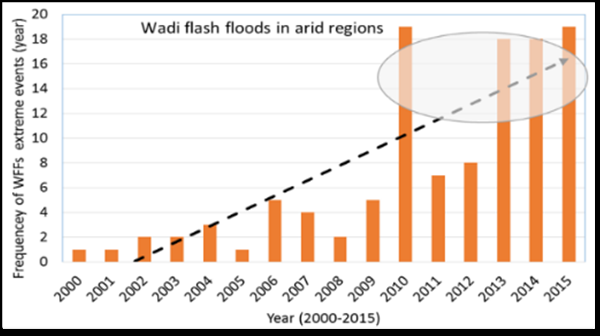
Wadi flash floods in arid regions chart

Observed extreme-event context

Illustrative trend in wadi flash-flood extreme events over 2000–2015, showing the increasing importance of flood extremes in arid environments.

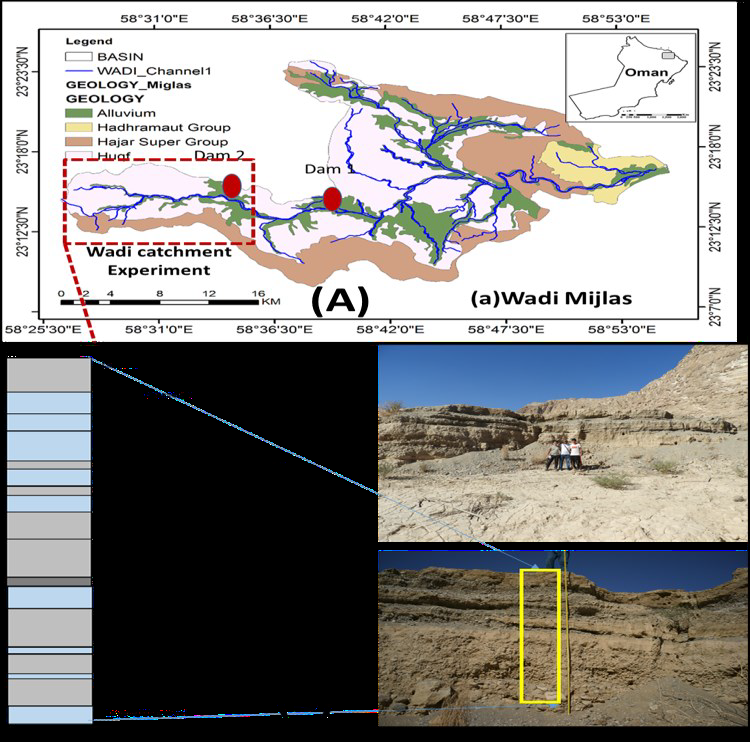
Wadi Mijlas map and field survey photographs

Wadi Mijlas field survey

Map, stratigraphic profile, and field photographs of slackwater flood deposits in Wadi Mijlas, Oman, including field investigations conducted in 2018 and 2025.

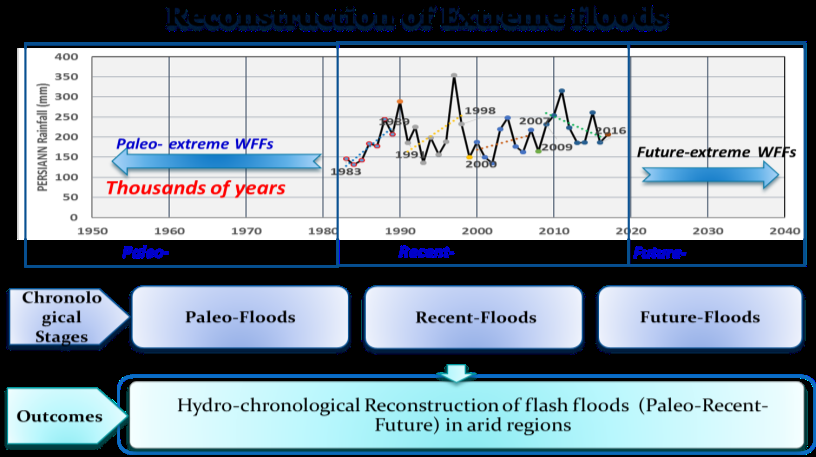
Chronological reconstruction framework of paleo recent and future floods

Chronological reconstruction framework

Conceptual workflow linking paleo-floods, recent floods, and future flood conditions within one integrated hydrochronological framework.

Collaborators and members

The project brings together expertise in paleoflood hydrology, water resources, climate extremes, geochemistry, geomorphology, and remote sensing across Oman, Japan, and Algeria.

Assoc. Prof. Mohamed Saber

Kyoto University project lead
DPRI, Kyoto University, Japan

Co-leads the project from the Japan side, manages scientific coordination, and oversees reporting and integration activities.

Dr. Soliman Mohammed

A collaborator
Military Technological College, Oman

supportingin the Project activities, field coordination, and scientific implementation.

Prof. Sameh Kantoush

Climate–flood integration
DPRI, Kyoto University, Japan

Supports integration of reconstructed flood records with regional climate drivers and broader hydrological interpretation.

Assoc. Prof. Kobayashi Sohei

Survey technology
DPRI, Kyoto University, Japan

Contributes UAV-based and sensor-supported survey methods for detailed topographic and field data acquisition.

Prof. Ali Al Maktoumi

Sediment analysis
Sultan Qaboos University, Oman

Supports sediment analysis for interpretation of climate, topography, and soil-forming controls within the catchments.

Dr. Osman A. Abdalla

Geochemistry and coring
Sultan Qaboos University, Oman

Leads geochemical analysis and core-sampling interpretation for reconstruction of past environmental conditions.

Dr. Mahmoud Alamammari

Field survey and dating support
MAFWR, Oman

Contributes to field surveys, local technical support, and core sample dating activities.

Dr. Tayeb Boulmaiz

Climate extremes analysis
University of Ghardaia, Algeria

Supports long-term hydroclimatic reconstruction and climate-extreme analysis relevant to arid-region flood dynamics.
Expected outcomes

The project is designed to generate both scientific advances and practical risk-reduction value for arid-region water and disaster management.

Scientific outputs

  • High-resolution flood chronologies for selected arid basins.
  • Quantified estimates of extreme flood magnitudes and frequencies beyond the instrumental record.
  • Improved understanding of flood–climate linkages in arid and semi-arid environments.
  • A transferable integrated hydrochronological framework for broader regional application.

Applied value

  • Improved flood-risk assessment in data-scarce regions.
  • Better long-term planning support for infrastructure and water resources.
  • Evidence base for adaptation strategies and disaster resilience.
  • Stronger foundation for future early-warning and hazard management systems.

Scientific foundation

The project builds on the established principles of palaeoflood hydrology, especially the use of slackwater flood deposits as robust palaeostage indicators, combined with age dating, hydraulic reconstruction, and flood-frequency analysis. This provides a strong methodological basis for extending flood records beyond the short instrumental period.

Contact us

For research collaboration, technical exchange, data discussion, or project-related communication, please use the contact details below.

Project contact at Kyoto University

Name
Assoc. Prof. Mohamed Saber
Affiliation
Water Resources Research Center, DPRI, Kyoto University
Address
Gokasho, Uji City, Kyoto 611-0011, Japan
Email
mohamedmd.saber.3u(at)kyoto-u.ac.jp